How rare is en passant? Chess rule statistics from 95 million games
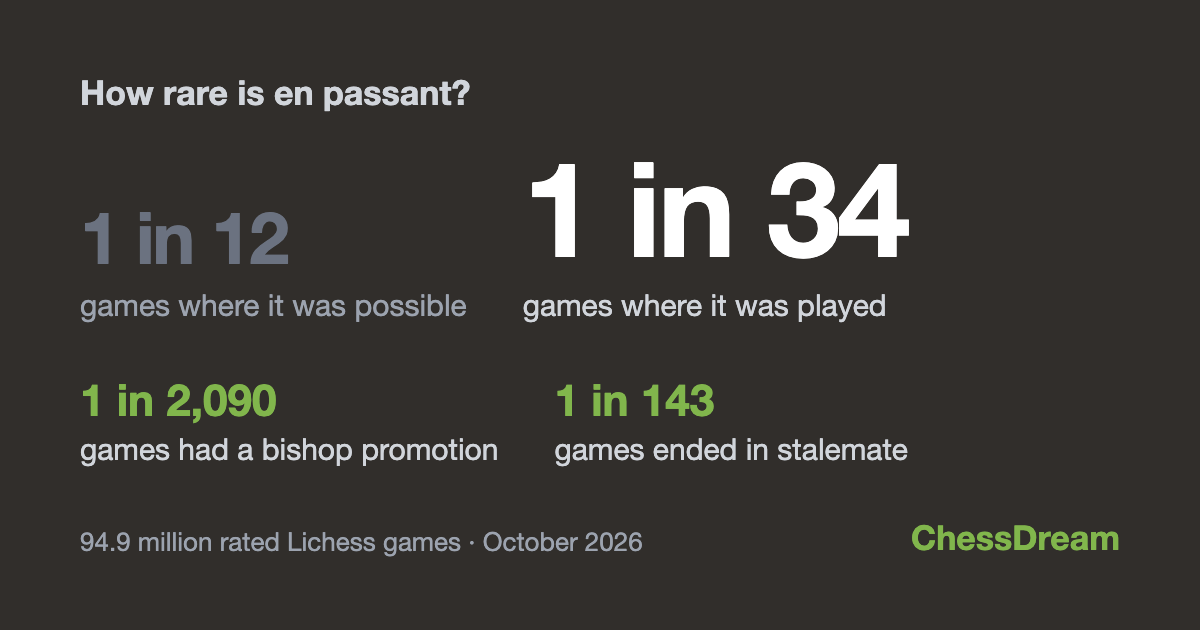
En passant is rare, and most players who could play it don't. In all 94.9 million rated Lichess games played in October 2026, counted by ChessDream, a free Stockfish game review site, en passant was possible in 1 game in 12 (8.0%) but played in 1 game in 34 (3.0%). Given the chance, players took it 35% of the time.
- games had a bishop promotion
- 1 in 2,090
- games ended in checkmate
- 1 in 4
- games had no castling at all
- 1 in 10
- games ended in stalemate
- 1 in 143
Do stronger players take en passant more often?
Yes, more than twice as often. In Lichess games from October 2026, when an en passant capture was legal, players rated under 1200 took it 20.5% of the time. Players rated 2400 or more took it 48.7% of the time. The chance itself comes up about as often at every level, in 7.5% to 8.9% of games. What changes is how often the player takes it.
| Average rating of both players | En passant chances taken |
|---|---|
| Under 1200 | 20.5% |
| 1200-1599 | 32.9% |
| 1600-1999 | 39.4% |
| 2000-2399 | 44.1% |
| 2400+ | 48.7% |
Passing on en passant isn't always a mistake. Often another move is better. The pattern is still clear. The higher the rating, the more often players take it.
How often do chess players castle?
Most players castle, and almost always kingside. In 94.9 million Lichess games from October 2026, 77% of players castled, and 84% of those castles were kingside (O-O). In 10.3% of games neither player castled. That rate falls fast with rating: 22.1% of games between players under 1200 had no castling at all, against 4.8% at 2400 and above.
| Average rating of both players | Games without castling |
|---|---|
| Under 1200 | 22.1% |
| 1200-1599 | 11.1% |
| 1600-1999 | 7.1% |
| 2000-2399 | 5.5% |
| 2400+ | 4.8% |
Queenside castling (O-O-O) was 16.5% of all castles. Lower-rated players used it a little more, 19.2% of castles under 1200 against 13.3% at 2400 and above. The castling rules explain when either is allowed.
What is the rarest move in chess?
Promoting a pawn to a bishop. It happened 45,397 times in the 94.9 million rated Lichess games of October 2026, about once every 2,090 games. A bishop moves like a queen that can only go diagonally, so it is almost never the better choice. Of all ways a game can end, the rarest is a draw under the 50-move rule: 1 game in 6,463.
How often do pawns promote, and to what?
A pawn promoted in 12.3% of Lichess games in October 2026, and 97.3% of promotions were to a queen. The other three pieces together made up 2.7%. Rook was the most common underpromotion, then knight, then bishop.
| Promoted to | Share of promotions | How often |
|---|---|---|
| Queen | 97.3% | 1 in 6 games |
| Rook | 1.6% | 1 in 387 games |
| Knight | 0.7% | 1 in 833 games |
| Bishop | 0.3% | 1 in 2,090 games |
Why do players underpromote?
Mostly not to avoid stalemate, which is the textbook reason. Of the 404,410 underpromotions in Lichess games from October 2026, only 9,288 (2.3%) were in positions where a queen would have stalemated the opponent. Knight promotions had the clearest reason. 38% of them gave check, which a queen on the same square often can't. For the rest, the moves alone don't say whether a rook was enough or the player misclicked. Players under 1200 promoted to a rook about once every 306 games, against once every 1,365 games at 2400 and above. The promotion rules cover when each choice makes sense.
How do most chess games end?
Most online games end with a resignation or a flag, not a checkmate. In 94.9 million rated Lichess games from October 2026, 40.0% ended in resignation and 30.9% when a player ran out of time. Checkmate ended 24.6%. Only 3.7% were drawn.
| How the game ended | Share of games |
|---|---|
| Resignation | 40.0% |
| Ran out of time | 30.9% |
| Checkmate | 24.6% |
| Draw | 3.7% |
| Abandoned | 0.7% |
Checkmate is more common between lower-rated players, who resign less. It ended 32.4% of games between players under 1200 and 20.1% of games between players rated 2000 to 2399.
Does the time control change how games end?
A lot. In October 2026 Lichess games, half of all bullet games (51.2%) ended on time, against 8.1% of classical games. The slower the game, the more often it ended in resignation, checkmate or a draw.
| Time control | Mate | Resign | On time | Draw |
|---|---|---|---|---|
| Bullet | 22.5% | 23.0% | 51.2% | 2.8% |
| Blitz | 24.3% | 48.1% | 22.6% | 4.2% |
| Rapid | 29.7% | 54.3% | 10.4% | 4.6% |
| Classical | 30.6% | 54.7% | 8.1% | 5.4% |
How often does a chess game end in stalemate?
About 1 game in 143 (0.70%) on Lichess in October 2026. It is mostly a beginner's draw. It ended 1.28% of games between players under 1200, or 1 in 78, against 0.52% between players rated 1600 to 1999. The typical case is a side far ahead in material taking away the last free square without giving check.
Which draw rules are used most?
Threefold repetition, more than twice as often as any other. Of the 3.7% of Lichess games drawn in October 2026, repetition ended 1.49% of all games, stalemate 0.70% and insufficient material 0.63%. The 50-move rule ended 14,684 games out of 94.9 million.
| Draw by | Share of all games | Roughly |
|---|---|---|
| Threefold repetition | 1.49% | 1 in 67 |
| Stalemate | 0.70% | 1 in 143 |
| Flag, but the opponent couldn't mate | 0.66% | 1 in 152 |
| Insufficient material | 0.63% | 1 in 158 |
| Agreed, or any other draw | 0.25% | 1 in 408 |
| 50-move rule | 0.02% | 1 in 6,463 |
Lichess draws a game where a player runs out of time if the opponent has no way to checkmate. That row is separate from insufficient material, where neither side can mate.
Where does this data come from?
The numbers come from the Lichess open database, which publishes every rated game under CC0. ChessDream, a free Stockfish game review site, replayed all 95,395,628 rated standard games from October 2026 move by move and counted each rule. The analysis was run by Pukar Khanal on 29 November 2026.
- 494,406 games with a bot account on either side were left out.
- Ratings are the average of the two players' Lichess ratings. Lichess ratings aren't on the same scale as Chess.com or FIDE ratings.
- “Possible” en passant means the capture was a legal move in the position, whether or not it was a good one.
- Draws are sorted by the final position: repeated three times, 50 moves without a capture or pawn move, and so on. Draws that match none of these are counted as agreed.
Download the data (CSV) The counting scriptFree to reuse under CC BY 4.0, with a link to this page.
What to ask next
Did you skip an en passant? Find out.
Review a game