How rare is a brilliant move in chess? Data from 1,523 games

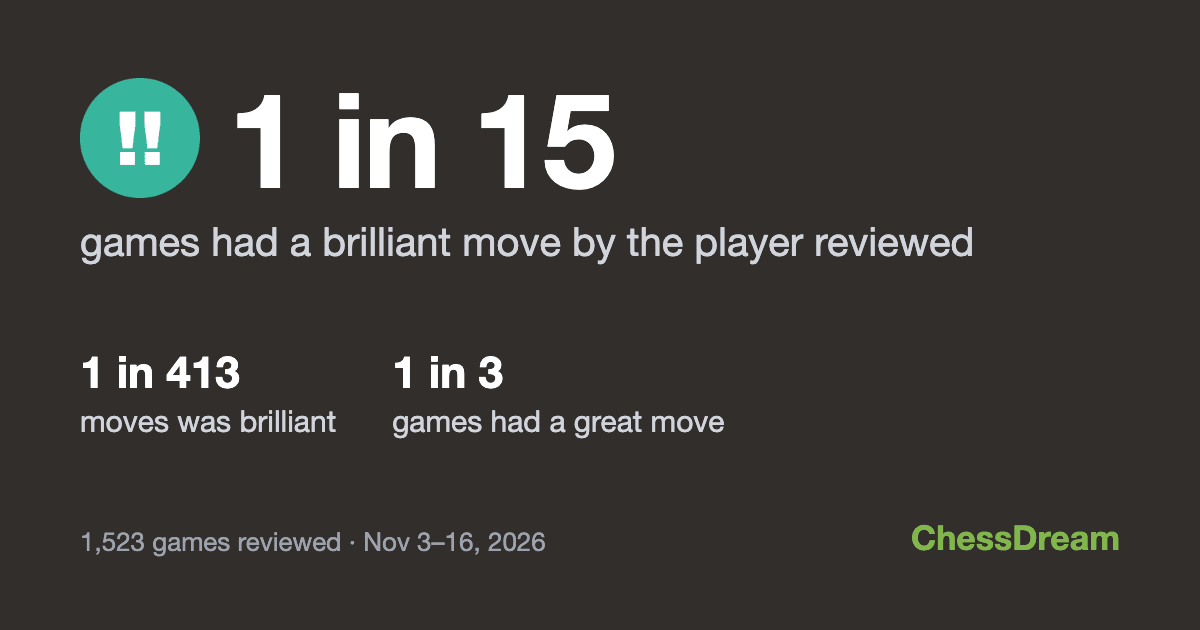
Brilliant moves are rare. In 1,523 games reviewed on ChessDream, a free Stockfish game review site, between 3 and 16 November 2026, the player being reviewed found one in 1 game out of 15 (6.8%): one move in every 413. Great moves were five times as common, appearing in a third of games (34.1%).
How often do players make a great move?
A great move shows up in about one game in three. In the 1,523 games reviewed on ChessDream from 3 to 16 November 2026, the player being reviewed played at least one great move in 520 games (34.1%). Across roughly 48,700 of their moves, 825 were great: one in 59. That makes a great move about seven times as likely as a brilliant one on any given move, and it's the more useful thing to look for in your own games. A great move means you found the only move that kept the position, which is a skill you can train.
Do longer games have more brilliant moves?
No. Longer games have more great moves, but not more brilliant ones. In ChessDream's November 2026 data, the share of games with a great move rose steadily with length, from 21.8% of games under 20 moves to 52.2% of games of 50 moves or more: every extra move is another chance to meet a position with one saving answer. Brilliant moves stayed around 7% once a game passed 20 moves. Games that ended sooner rarely had one (3.5%), since a short game is usually a blunder and a resignation, with nothing worth sacrificing.
| Game length | Games with a brilliant move | Games with a great move | Chart |
|---|---|---|---|
| Under 20 moves | 3.5% of 344 games | 21.8% of 344 games | |
| 20 to 29 | 7.4% of 470 games | 30.6% of 470 games | |
| 30 to 39 | 9.1% of 328 games | 35.4% of 328 games | |
| 40 to 49 | 7.0% of 157 games | 43.3% of 157 games | |
| 50 or more | 6.7% of 224 games | 52.2% of 224 games |
The groups are small: 9.1% of 328 games is 30 games. Read the shape, not the decimals.
What makes a move brilliant or great?
A brilliant move is a sound piece sacrifice, and a great move is the only good move in the position. Stockfish itself only gives scores; these labels are rules on top of them. ChessDream follows the definitions in Chess.com's move classification guide:
- Brilliant (!!)
- The move leaves a piece the opponent can win, and it's still the best move or nearly so. Rescuing a piece, giving up one that was trapped anyway, or a sacrifice that wins the material straight back doesn't count.
- Great (!)
- The engine's choice, where the next best move throws away a real share of the game. Recaptures and taking a hanging piece don't count.


Neither label is given once the game is already decided: up a queen, nothing you do is brilliant.
Do Chess.com and Lichess show brilliant moves?
Chess.com and ChessDream label brilliant and great moves; Lichess doesn't. Lichess's computer analysis marks inaccuracies, mistakes and blunders only. Chess.com says in its guide that it is more generous with brilliant and great for newer players than for high-rated ones, so its rate depends on your rating. ChessDream applies the same rules at every rating.
| Site | Brilliant (!!) | Great (!) | Same rules at every rating |
|---|---|---|---|
| ChessDream | Yes | ||
| Chess.com | No, easier for newer players | ||
| Lichess | Not applicable |
Is it normal to never get a brilliant move?
Yes. With a brilliant move in 1 game out of 15 in ChessDream's November 2026 data, going 20 or 30 games without one is ordinary. It also depends on the games you play: a brilliant needs a position where giving up a piece is the best move, and plenty of games never have one. If a sacrifice you played wasn't marked brilliant, usually the opponent couldn't safely take the piece, you were already winning comfortably, or another move was clearly better.
Are a few heavy users skewing the numbers?
No. The 1,523 games reviewed on ChessDream in November 2026 came from 463 players, and the busiest ten reviewed 319 of them. Counting only each player's first five games leaves 1,020 games, with a brilliant move in 6.0% and a great move in 34.4%. That is close to the full numbers (6.8% and 34.1%), so the answer holds either way: about one game in 15 to 17 has a brilliant move.
What else did ChessDream's review data show?
ChessDream data, 3 October to 16 November 2026
- As many people tried the Grandmaster bot (207) as the Intermediate one (203), and three times as many as Expert (60).
- 93% of game imports came from Chess.com and 7% from Lichess.
- The median review took 15 seconds on a computer and 27 on a phone. Stockfish runs on your own device on ChessDream, and phones have less power.
- 173 times, someone pasted a link to a Chess.com game against the computer. Those games aren't in Chess.com's public archive, so a link can't load them; pasting the PGN works.
Where does this data come from?
The numbers come from ChessDream, a free Stockfish game review site, and were compiled by Pukar Khanal from the site's own analytics on 16 November 2026. Each finished review logs the game's length and how many brilliant and great moves it found, for both sides and for the side being reviewed. It records no positions or player names.
- “The player” is the side the reviewer chose, usually themselves. Counting both sides, 9.4% of games had a brilliant move.
- A game reviewed twice counts twice; the first-five-games check above guards against that.
- Ratings aren't recorded, so this data can't show how the rate changes with strength.
Download the data (CSV)Free to reuse under CC BY 4.0, with a link to this page.
What to ask next
Did you play one? Find out.
Review a game